We are excited to announce our keynote speakers for MobileHCI 2026. For the full schedule, please see the Program at a Glance or the interactive SIGCHI Program Web App.
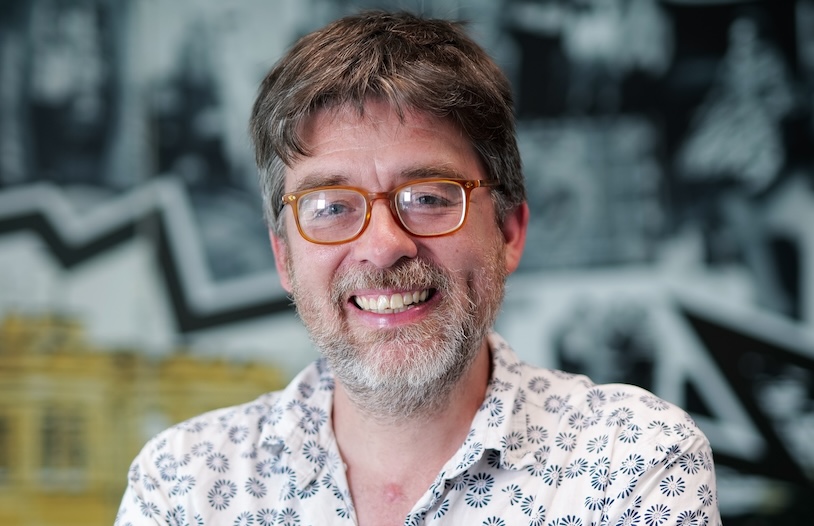
Opening Keynote: Michael Evans
Interdisciplinary Research Lead and Human Factors Engineer, BBC R&D
Time: Tuesday 1st September, 09:30 - 10:30
Venue: Great Hall Auditorium
Title: Festivals of Investigation: the Power of Interdisciplinary Research in Creative Industry and Beyond
Abstract: Part of what makes HCI such a rich field is that researchers like us arrive from so many professional backgrounds. Whether we started out as psychologists, designers, engineers, or social scientists, HCI research rewards us when we work where these disciplines intersect. Then, it creates the most value when we position our research back across all the contexts and environments that we came from as a community.
For me and my colleagues, this makes our work particularly exciting, as we’ve all chosen to work in the creative industries, supporting the experience of content producers and their audiences.
BBC Research and Development has a substantial engineering heritage, dating back to 1922. In this still new century, we’ve had the challenge of becoming more interdisciplinary in our research approaches. I’ll tell you about a few key BBC R&D projects, past and present, through which we’ve learned about the challenges and the power of our ability to change, and grow, as researchers.
Bio: I'm an interdisciplinary research lead and human factors engineer at the BBC’s R&D laboratories. Working with my BBC colleagues and a range of industry and university partners, I’ve helped develop innovative production tools and audience experiences for the public service media of the future. We have to be experts, not only in the enabling technologies for universal, high-quality, and increasingly personalised media content, but also how to deliver and understand the value of these experiences. I’ve put human-centred computing at the centre of many research programmes; delivering advances in the creation of immersive video, ethical AI in media production, and values-centric quality of experience evaluation.
Over a number of years I made a particular contribution to enhancing the accessibility of media for disabled people, including some award-winning innovation deployed at large scale in consumer electronics and in international standardisation; pioneered use of the Edinburgh Festivals, and similar events, as ‘living labs’; for in-the-wild deployment of production prototypes; and created the BBC’s User Experience Research Partnership, a multi-year strategic collaboration with six top UK HCI research groups.
I got my DPhil in spatial audio and psychoacoustics at British Telecom Labs/University of York in 1997 and I'm a Chartered Engineer. Before joining the BBC in 1999, I was a lecturer in Computer Science at the University of Reading; leading research there into auditory interfaces and co-founding the Signal Processing Laboratory. I have served on the UK research councils’ Strategic Advisory Teams for Digital Economy, and for ICT. I’m currently a scientific adviser to two UK Government departments, as a member of the Colleges of Experts for both Culture, Media and Sport (DCMS), and Science, Innovation and Technology (DSIT).

Closing Keynote: Yvonne Rogers
Professor of Interaction Design, University College London
Time: Thursday 3rd September, 16:00 - 17:00
Venue: Great Hall Auditorium
Title: Out of our minds and into our pockets
Abstract: By ‘out of our minds’ I mean how we externalise and offload various aspects of cognitive work through writing, drawing, talking and so on. In so doing, it helps us to articulate our half-baked ideas, partially-solved problems, generate new ideas and construct plans. AI is the latest technological tool that we use to do this. However, it is a very different kind of beast to the armoury of previously used computer-based tools. GenAI can amplify human cognition in extraordinary ways but sometimes at the expense of reducing the cognitive effort required to think, write, analyse, code, decide, and create, for ourselves, resulting in us potentially becoming lazy and over-dependent on it. Will this dilemma get worse with the advent of mobile AI - where AI is embedded in wearables, smartphones and AR glasses? Or will we be able to leverage AI on the move to good effect - having a helpful voice in our ears and AI in our pockets, that is ready to give answers, reminders, directions and advice when needed. In my talk, I will describe the research I have been doing investigating how best to extend human minds that can be both rewarding and challenging: enabling us to reason and make decisions more systematically through reflecting on our goals and intent.
Bio: Yvonne Rogers is a Professor of Interaction Design at University College London. Her research is concerned with designing interactive technologies that empower humans. Her current focus is developing human-centred AI tools to think and reflect with. Central to her work is a critical stance towards how visions, theories and frameworks shape the fields of HCI, cognitive science and ubiquitous computing. She been instrumental in promulgating new theories (e.g., external cognition), alternative methodologies (e.g., in the wild studies) and far-reaching research agendas (e.g., “Being Human” manifesto) and has pioneered an approach to innovation and ubiquitous learning.
She has received various awards including being elected as an international member of the American National Academy of Engineering, the ACM SIGCHI Lifetime Achievement Research Award, a Fellow of the Royal Society and the Royal Society Robin Milner Medal for computer science. She was also awarded a Chair of Excellence from the University of Bremen. She is one of the authors of the definitive textbook on Interaction Design and HCI now in its 6th edition, that has sold over 300,000 copies worldwide and has been translated into many languages. She is also an alumna of Swansea University and loves visiting the Gower Peninsula.